

How to Protect Medium-to-Large Sites at Night with Limited Security Staff
Why Night Security Is Challenging for Medium-to-Large Sites
In relatively large areas such as factories, warehouses, parking lots, and outdoor storage sites, it becomes difficult to keep an eye on everything at night.
With fewer staff on site, it can take longer to notice unusual situations.
Security guards’ patrols and camera monitoring are commonly used.
However, it is not realistic for a small number of staff to watch the entire site at all times.
What matters most in nighttime security is not to watch everything, but to notice unusual activity as early as possible.
In this article, we introduce key ideas and practical points to help protect large sites with limited security staff.
Start by Identifying High-Risk Areas
Trying to protect every area in the same way can reduce efficiency and increase the risk of missing something.
Instead, start by looking at the site from two key perspectives:
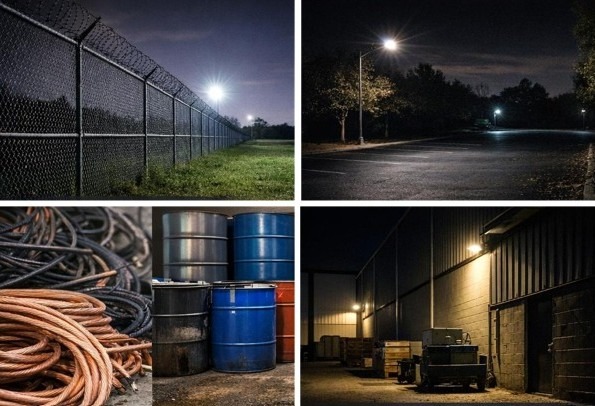
1. Areas where intrusion or blind spots are more likely
- Fence lines or boundaries
- Gates and entrances
- Dark or low-traffic areas
- Back sides of buildings or hidden spots
2. Areas with a higher risk of theft or damage
- Expensive equipment or machinery
- Storage areas for materials or products
- Items that can be easily resold, such as metal or fuel
- Tools or vehicles that are easy to take
Think in Zones When Managing Your Site
To protect a site with limited staff, it is important to divide the area into zones based on their roles.
Instead of applying the same measures to every area, you should clearly define what needs to be protected in each zone and why.
Below are some typical examples of zones, along with their purpose and basic approach to protection.
| Zone | Purpose | Approach |
|---|---|---|
| Perimeter / Fence line | Detect intrusion early | Use sensors to detect intrusion |
| Gate / Entrance | Control entry and exit of people and vehicles | Use cameras, lighting, and guard checks |
| Storage area | Protect valuable items | Focused monitoring with sensors and cameras |
| Building entrance | Prevent intrusion into buildings | Detect and notify at door areas / Access Control |
| Remote / dark areas | Reduce blind spots | Monitoring with sensors and cameras |
Most importantly, you should focus not only on areas where intrusions are likely, but also on areas where the impact of damage or theft would be high (such as storage areas with valuable equipment or materials).
By applying this approach, even a small team can build a more efficient and practical security system.
Use Cameras for Confirmation, Not Continuous Monitoring
It is difficult to watch camera footage all the time, and it increases the risk of missing something.
This is especially true at night, when there is less movement. Watching multiple screens for a long time can lead to missed incidents and loss of focus.
For this reason, cameras are best used for checking situations when something unusual happens.

Cameras are useful for recording and confirming events, but they have limits when it comes to noticing problems early or responding immediately.
So by checking the camera footage when an alert is triggered, staff can quickly understand the situation and make the right decision.
``Early Detection`` Is the Key
Many problems are often noticed only after damage has already occurred.
If unusual activity can be detected at an earlier stage — such as at the fence line or perimeter — there is more time to respond.
By using sensors and similar systems, it is possible to detect and notify unusual activity even when no one is watching.
Early detection provides several benefits:
- Faster response
- Reduced risk of damage spreading
- Better understanding of the situation on site
Help Security Staff Focus on Response
By using sensors and cameras, security staff can focus not only on patrols, but also on necessary actions.
The basic process is simple:
- Detect unusual activity
- Check the situation using cameras
- Respond if necessary
Set Clear Response Rules in Advance
It is important to prepare not only the system, but also clear response procedures.
- Who checks the alarm
- Who reviews the camera footage
- When/how to take action on site
- Who should be contacted
By defining these in advance, even a small team can respond smoothly and consistently.
Summary
It is difficult to monitor every part of a medium-to-large site with human eyes, especially at night.
What really matters is to build a system that allows you to notice unusual activity early.
The key points are:
- Identify high-risk areas
- Divide the site into zones and define their roles
- Use cameras for confirmation
- Detect unusual activity early with sensors
- Help security staff focus on response
- Set clear response rules in advance
By applying this approach, even a small team can achieve more efficient and reliable nighttime security.
OPTEX provides a range of sensors and solutions to support nighttime security for factories, warehouses, and outdoor facilities.
If you are looking for a better way to protect your site, feel free to contact us.
Contact OPTEX
Please feel free to contact us for further information.
We are always eager to support you and propose a solution that suits your needs.