
What Determines the Value of PIDS? - Reliable Detection
What Is PIDS (Perimeter Intrusion Detection System)?
PIDS (Perimeter Intrusion Detection System) is a security system that uses sensors installed along the perimeter of a property or facility to detect unauthorized intrusions at an early stage. By integrating these sensors with video surveillance systems and security operations, the system enables monitoring and initial response triggered by detection events.
By identifying abnormalities at the perimeter — the first point of intrusion, it allows security personnels to take action before an intruder reaches the inside of the building.
We explain the basic mechanisms, system components, and common use cases of PIDS in detail on the page below:
👉 What Is a PIDS (Perimeter Intrusion Detection System)?
PIDS Is Evaluated Not by Its “Mechanism” but by the Quality of Its Detection
PIDS is not merely a setup for deploying sensors or cameras around a site.
What defines an effective PIDS is its ability to deliver reliable intrusion detection. If the primary detection layer is unstable, the integrity of everything that follows—video verification, monitoring, and response procedures—quickly deteriorates.
For this reason, the true value of a PIDS is measured by how consistently it can maintain high detection performance and accuracy.
When evaluating detection capability, it is essential to look beyond a simple percentage figure.
The real question is: how frequently would an intrusion remain undetected during actual operation?.
Unless the detection rate is 100%, some events will inevitably go unnoticed (for example, a 90% rate means one undetected intrusion in every ten attempts).
With this perspective in mind, organizations must determine what level of detection certainty is required for their security posture and risk tolerance.
The Relationship Between False Alarms and Missed Detections
— A Key Factor in Detection Reliability
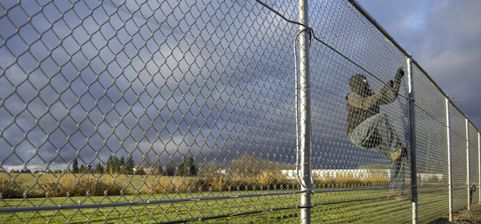
Because PIDS are primarily deployed in outdoor environments, they are exposed to many potential sources of false alarms, including
- weather changes
- moving vegetation
- small animals
- variations in lighting conditions
If sensitivity is reduced to suppress false alarms, the system’s detection capability will also decrease, increasing the risk of missed detections—failing to detect intrusions that should have been captured.
In designing and operating a PIDS, it is essential to find an appropriate balance between the acceptable frequency of false alarms and the required level of detection performance.
Where this balance can be set depends greatly on the sensor’s detection principle, design philosophy, and resistance to environmental factors.

Why False Alarms and Missed Detections Become Critical Issues in High‑Security Facilities
● Impact of False Alarms on Site Operations
When false alarms occur frequently, they lead to several operational issues:
- Increased workload for security officers and operators
- Reduced trust in alerts (risk of operators ignoring notifications)
- Slower response to alerts that actually require action
These problems are not merely about cost or efficiency and directly degrade the overall quality of security operations.
● Why Missed Detections Are Even More Critical
Missed detections pose a far more serious threat. If an intrusion goes unnoticed, the incident will be discovered only after it has already occurred.
A lower number of false alarms does not mean the system is performing well if intrusions are being missed.
This is especially critical in:
- Critical infrastructure sites
- Manufacturing plants and logistics hubs
- Research facilities and other high‑value installations
In such environments, a single missed detection can lead to severe damage, major operational disruption, or even complete shutdowns.
From a perimeter security perspective, it represents the most catastrophic failure mode.
Therefore, in high‑security facilities, the key question is not “How often does the system detect intrusions on average?”
but rather: “Is the system designed with the expectation of minimizing missed detections?”
Key Considerations When Using AI‑Based Video Analytics for Perimeter Monitoring
In recent years, video analytics and AI technologies have advanced significantly and now play an important role in identifying suspicious behavior and providing situational awareness.
Video‑based monitoring is also a valuable verification method within PIDS.
However, when the objective is perimeter intrusion detection, video‑centric monitoring has certain limitations due to its dependency on environmental conditions.
Outdoor perimeter environments are constantly affected by factors such as:
- Weather conditions (rain, fog, backlighting)
- Illumination changes between day and night
- Shadows and moving vegetation
- Resolution limitations caused by blind spots or distance
While video surveillance can still provide situational awareness under these conditions, its detection capability inherently relies on maintaining a visible and interpretable scene.
For this reason, perimeter systems must be designed with the expected variability of detection performance under changing environmental conditions in mind.
What matters is not the performance of AI or video analytics in isolation, but rather how the system compensates for the characteristics that directly affect detection rates.
Why Sensor‑Based PIDS Technologies Are Effective
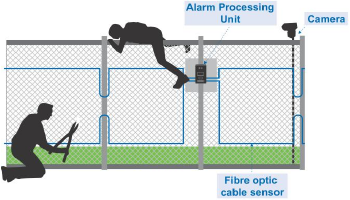
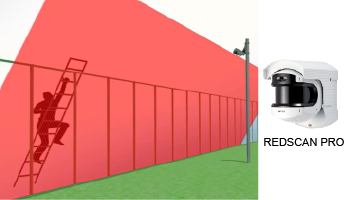
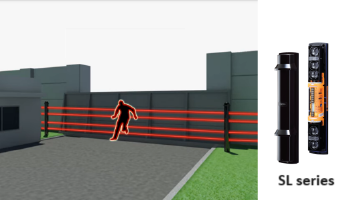
Sensor‑based PIDS technologies—such as active infrared sensors, LiDAR sensors, and fiber‑optic systems—monitor the perimeter using a fundamentally different approach from video analytics.
What these physical sensors detect includes:
- Interruption of infrared beams
- Intrusion into a laser‑defined area
- Physical disturbances applied to fences or structures (e.g., vibration)

In other words, they detect the intrusion event itself, rather than determining whether an intruder is visually observable. This approach focuses on capturing the conditions under which an intrusion is physically realized, not on interpreting visual information.
Although physical sensors cannot completely eliminate the influence of environmental conditions, differences in detection principles, sensor design, and environmental robustness significantly affect how much variation in detection performance can be suppressed.
By building a video monitoring system that is triggered by high‑reliability physical sensors, it becomes possible to maintain a high detection rate while keeping false alarms at a manageable level.
Why OPTEX PIDS Sensors Have Earned Long‑Term Trust
OPTEX has long focused on designing sensors for harsh perimeter environments as a fundamental assumption.
To reduce the risk of false alarms and missed detections that can occur outdoors, our sensor design emphasizes:
- Strong resistance to environmental fluctuations
- Long‑term operational stability
- Design optimized for on‑site adjustment and practical deployment
With a diverse lineup of physical sensing technologies—including photo‑beam sensors, LiDAR sensors, and fiber‑optic sensors — you can select or combine the most suitable detection methods to build a PIDS configuration tailored to each site’s characteristics and risk profile.
For details on the features and applications of each sensor, please see the product pages below.
Conclusion: The Value of a PIDS Is Defined by the Reliability of Its Detection
PIDS is a perimeter defense system that integrates sensors, video monitoring, and security operations. However, in practice, many systems end up in a state where they are installed but not relied upon due to issues such as frequent false alarms or insufficient detection reliability.
To ensure that a PIDS functions as a true decision‑making trigger — rather than merely existing as infrastructure — it is essential to maintain the level of reliability required for on‑site operations on a continuous basis.
At OPTEX, we support sensor selection and PIDS configuration based on each site’s perimeter conditions and operational requirements, helping address location‑specific challenges.
If you are asking yourself:
- “Is our current PIDS truly contributing to daily operations?”
- “Are false alarms or detection performance creating operational issues?”
please feel free to contact OPTEX. We would be glad to discuss how to enhance the reliability and effectiveness of your perimeter detection system.
Contact OPTEX
Please feel free to contact us for further information.
We are always eager to support you and propose a solution that suits your needs.